
Software Engineering - Process Management
Establish complete traceability throughout the R&D lifecycle, complying with high-reliability industry standard requirements such as ISO 26262, ISO/SAE 21434, and ASPICE.
What is Requirements Management? Why is it important?
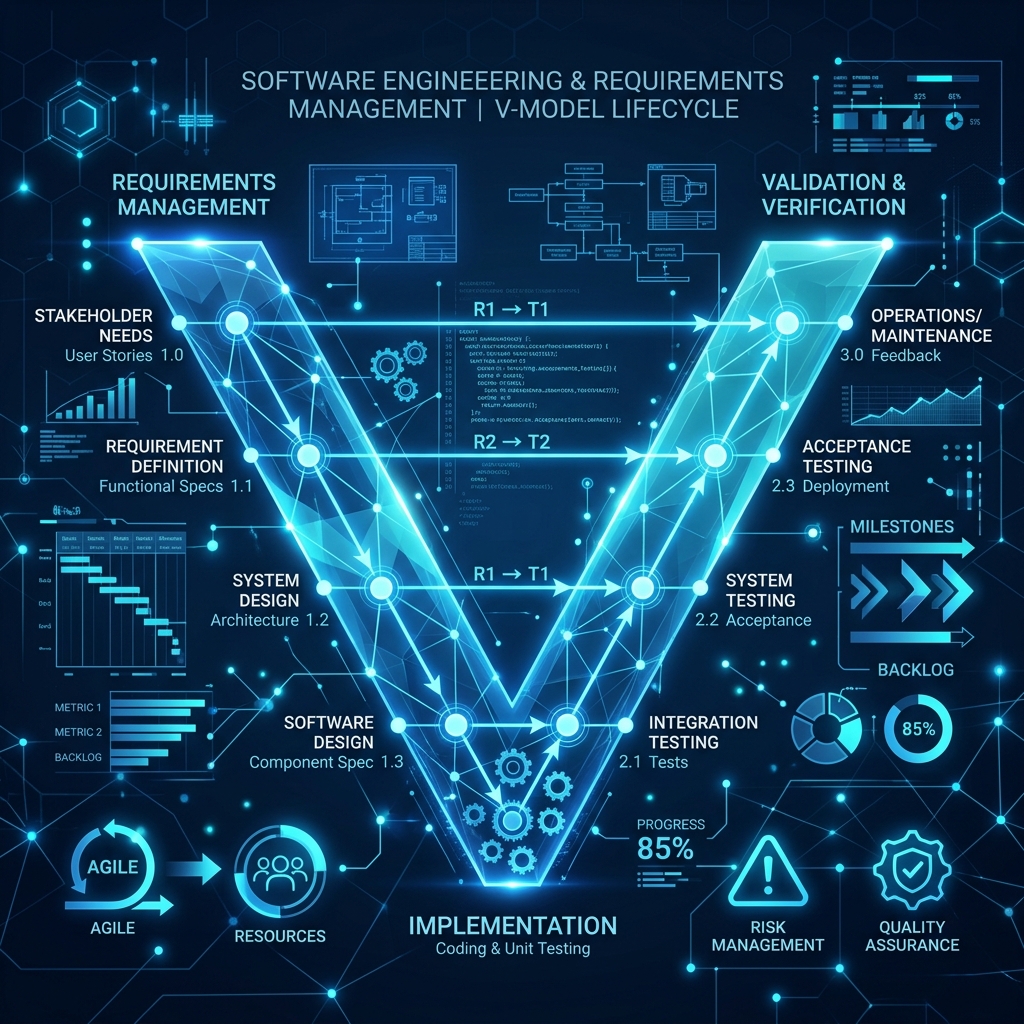
Requirements management is the core foundation of software and systems engineering, especially in industries with high safety requirements like automotive electronics. Standards such as ISO 26262 for functional safety, ISO/SAE 21434, and ASPICE (Automotive SPICE) all explicitly mandate establishing bidirectional traceability from 'upper-level system requirements' and 'software/hardware design' down to 'test verification'.
Simply put, the goal of requirements management is to ensure the R&D team is 'doing the right things' and 'doing things right.' It covers the collection, analysis, definition, and version change control of system requirements, as well as their correlation with subsequent test cases. Without an effective requirements management platform, it is easy to encounter R&D delays and quality risks caused by ambiguous requirements or unsynchronized changes, making it extremely difficult to pass rigorous compliance audits.
Challenges in Requirements Management and V-Model Development
- check_circle Cross-Department Collaboration Difficulties:System, software, hardware, and test teams often use different tools or systems, leading to information silos.
- check_circle Difficulty Assessing Change Impacts:When customer requirements or designs change, it is difficult to quickly and accurately track and assess the affected design modules and test cases.
- check_circle Lack of End-to-End Traceability:Relying on manual work makes it hard to prove that every requirement has corresponding implementation and verification, causing failures in passing ASPICE audits.
- check_circle Document Versioning and Review Chaos:Relying on traditional Word/Excel documents for management not only carries high risks of version conflicts and loss but also fails to implement real-time electronic signatures and historical records.
ALM and V-Model Integrated Solutions
For complex product R&D, Jotactic provides requirements management and V-Model collaborative development solutions centered around Siemens Polarion ALM, accelerating compliance and ensuring projects are delivered on schedule.
Unified ALM Platform and 100% Bidirectional Traceability
Supports complete V-Model lifecycle management. Uses a unified interface to manage upper-level system requirements, software architecture, all the way down to the underlying source code and test cases. Ensures 100% bidirectional traceability, outputting traceability matrices and compliance reports that meet ISO 26262/ASPICE requirements with a single click.
Siemens Polarion ALMRequirements Verification and Quality Assurance (QA)
Tightly integrates test management with requirements management to ensure every defined requirement is covered and correctly verified. The built-in test execution module allows importing results from third-party testing tools (such as automated unit testing or HIL/SIL testing) to form a closed quality loop.
Test ManagementReal-time Review and Cross-Team Collaboration (Reviewer)
Say goodbye to tedious document passing. Provides web-based real-time review mechanisms and Electronic Signatures. Team members and stakeholders can discuss, approve, and reject directly on the system, retaining all historical versions and operation records to ensure accountability and transparency.
Review & ApprovalSaaS and Flexible Deployment
Supports cloud SaaS deployment and On-Premises server deployment. Can be flexibly adjusted according to the size of the R&D team and provides open APIs for easy integration with the enterprise's existing IT infrastructure (e.g., Jira, Git, SVN, etc.), protecting existing investments.
Enterprise ScalabilityREST API Third-party Tool Synchronization
Polarion has built-in Jira integration, providing diverse tool application scenarios. The open REST API provides seamless development information synchronization.
DevSecOps CI/CD Tool Deployment
Empowered by Jenkins, integrating dynamic and static testing tools to assist in test execution, providing greater time flexibility and real-time capabilities.