dSPACE ADAS / AD Hardware Validation Solution: Integrated HIL Testing Bench from Sensors to Full Vehicle
With the explosion in the number of sensors for autonomous driving (L2+ to L4/L5) systems and algorithm architectures moving towards deep multi-sensor fusion, scenario validation mileage has reached hundreds of millions of kilometers. Faced with surging extreme long-tail conditions, the high cost and safety risks of actual road testing have become an R&D bottleneck.
Jotactic provides dSPACE ADAS / AD Hardware-in-the-Loop (HIL) physical validation solutions. Through a highly reliable real-time computing platform and cutting-edge raw sensor signal injection technology, we 100% digitally twin the full vehicle and road network environment in the laboratory, assisting your Domain Controller in completing 24/7 highly reliable closed-loop regression testing before being deployed in actual vehicles.
Core Mental Model: Deterministic Real-time Closed-loop System Architecture
The core value of dSPACE ADAS/AD HIL lies in constructing a high-precision, low-latency, and absolutely deterministic closed-loop control chain. After receiving high-fidelity virtual sensor data, the Autonomous Driving Domain Controller under test (SUT) outputs throttle, braking, and steering commands, which are instantly fed back to the vehicle dynamics model, forming a dynamic loop.
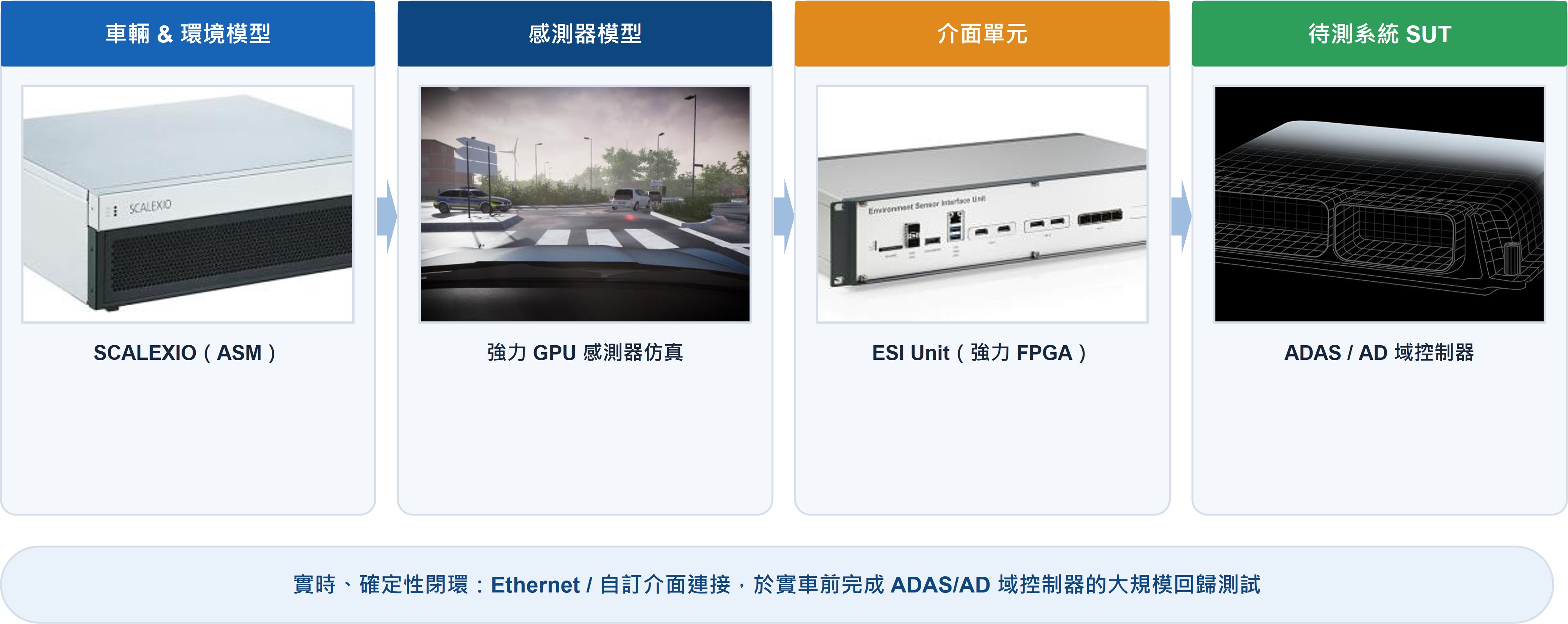
HIL Core Hardware Components: SCALEXIO Real-time Platform and ESI Unit
To meet the real-time throughput of millions of point clouds and cinematic visual images, it must rely on top-tier central computing and signal modulation hardware:
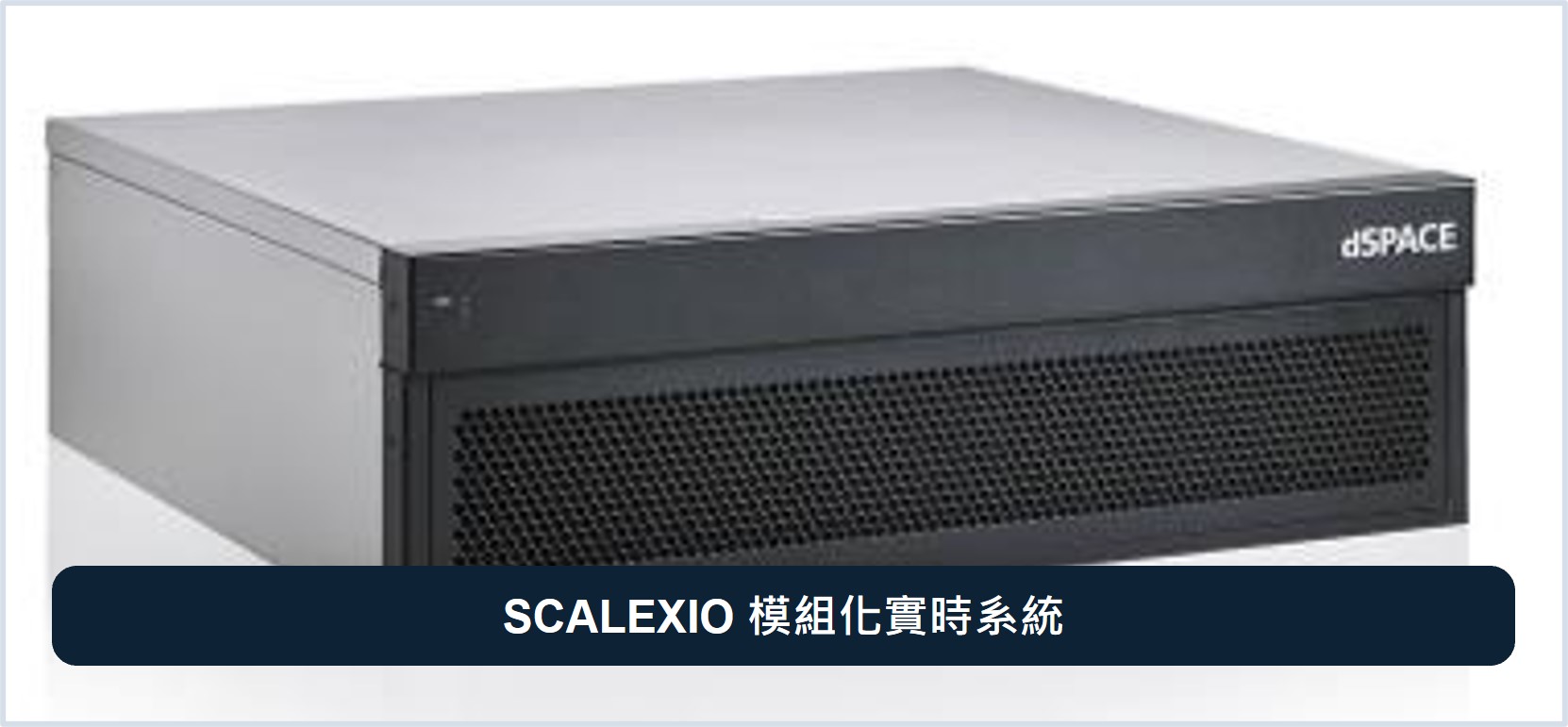
1. SCALEXIO Modular Real-time System
Equipped with the latest generation of high-performance multi-core processors, purpose-built for executing complex Automotive Simulation Models (ASM) and dynamic traffic flows.
Features hardware-level real-time determinism, ensuring timing jitter for all restbus simulation, I/O sampling, and physical equation calculations is controlled within microseconds. Available in various form factors from LabBox (desktop) to Rack (standard cabinet), expanding flexibly based on testing scale.
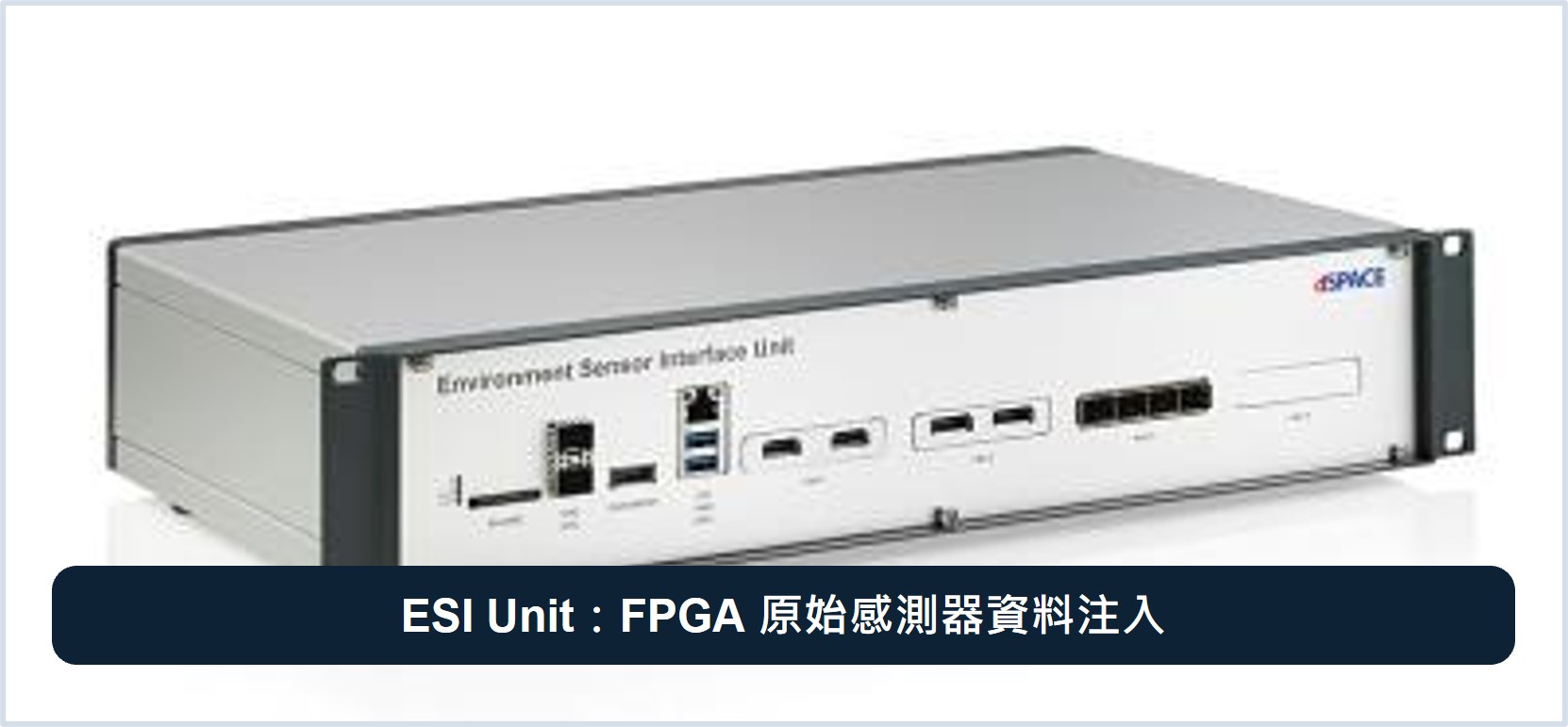
2. ESI Unit (Environment Sensor Interface)
A powerful FPGA dedicated interface unit designed specifically for handling 'Raw Data Injection' of sensors.
Data generated by AURELION cannot be directly input into controller chips; the ESI Unit is responsible for real-time encoding of virtual point cloud and image data streams under ultra-low latency into serialized protocols and electrical signals accepted by the physical controller hardware.
Key Technical Highlights: Multi-level Sensor Front-end Simulation and Injection
Different Systems Under Test (SUT) are at different stages of development. dSPACE HIL supports three major levels of data injection methods from 'Object List' to 'Low-level Physical Signals':
1. Object-level Injection
(Object-Level Injection)
- • Implementation Method:The simulation environment directly outputs Bounding Boxes, relative positions, velocities, and classification lists of detected targets.
- • Transmission Interface:Directly fed into the controller's fusion and planning modules via Automotive Ethernet (SOME/IP or custom UDP protocols) or CAN FD.
- • Applicable Scenarios:Focused on validating ACC cruising, AEB braking decision logic, path planning, and Fail-Safe security mechanisms during the R&D stage.
2. Signal/Protocol-level Injection
(Protocol-Level Injection)
- • Implementation Method:Packages camera target recognition results and radar detections according to the sensor supplier's proprietary protocols.
- • Applicable Scenarios:Directly validates the domain controller's multi-source data fusion algorithms and communication robustness without dismantling the sensor hardware casing.
3. Physical-level Raw Data Injection
(Raw Data Injection)
This is the core technology of advanced ADAS HIL. Implements physical-level hardware hook-up directly at the front end of the sensor chip (wafer-level) or data deserializer chip:
- 📸 Visual Camera (Camera HIL):Uses AURELION to render cinematic RGB video in real time via a powerful GPU. Serializes images into GMSL2 or FPD-Link III signals through the ESI Unit, skipping the physical lens and directly 'injecting' them into the domain controller's image input port.
- 📡 Millimeter-wave Radar (Radar HIL):Supports electromagnetic RF simulation (physical waves emitted by target simulators in a microwave anechoic chamber) or uses data streaming to directly inject raw data after Doppler range resolution.
- 🚨 Lidar HIL:Under ultra-low latency, millions of 3D physical point cloud data are directly fed into the domain controller's Lidar data receiving module via high-frequency Ethernet.
Data and Software Chain Ecosystem Integration
The power of dSPACE hardware validation solutions also stems from its perfect closed-loop software ecosystem support, ensuring seamless data flow between software and hardware:
Scenario and Environment Construction (ModelDesk & ASM)
Graphical editor, fully supporting map formats like OpenDRIVE and golden regulatory scenario libraries (e.g., Euro NCAP, UN R157 ALKS).
Physical Simulation Hub (AURELION)
Utilizes advanced GPU Ray-Tracing technology to accurately simulate the reflection characteristics of light and electromagnetic waves under rain, snow, dense fog, and special night lighting, automatically outputting semantic segmentation and depth ground truth.
Experiment Control and Automated Testing (ControlDesk & AutomationDesk)
Provides a unified experiment monitoring HMI, and drives the HIL bench via Python scripts (RTT SDK) compliant with ASAM XIL standards for 24/7 offline automated batch testing, automatically outputting comprehensive KPI scoring reports.
Core Engineering Benefits of Enterprise HIL Implementation
Absolute Safety, Zero Risk
100% reproduces highly dangerous extreme and harsh conditions (such as 'ghost probes', malicious cut-ins by leading vehicles, rainstorms, backlighting, and glare) in the laboratory, eliminating personal and equipment risks associated with actual road testing.
Ultimate Efficient Regression Testing
Through an automated pipeline, thousands of regulatory and boundary scenarios can be automatically run within hours, significantly shortening the software release cycle.
Determinism and 100% Reproducibility
Sporadic 'phantom braking' or software crashes during road testing are difficult to capture. In the dSPACE HIL environment, all signals and timing can be precisely controlled and are completely repeatable, allowing algorithm engineers to debug accurately.